FIGURE OF SPEECH
Figure of Speech
Figure of speech
any intentional deviation from literal statement or common usage that emphasizes, clarifies, or embellishes both written and spoken language. Forming an integral part of language, figures of speech are found in oral literatures as well as in polished poetry and prose and in everyday speech. Greeting-card rhymes, advertising slogans, newspaper headlines, the captions of cartoons, and the mottoes of families and institutions often use figures of speech, generally for humorous, mnemonic, or eye-catching purposes. The argots of sports, jazz, business, politics, or any specialized groups abound in figurative language.
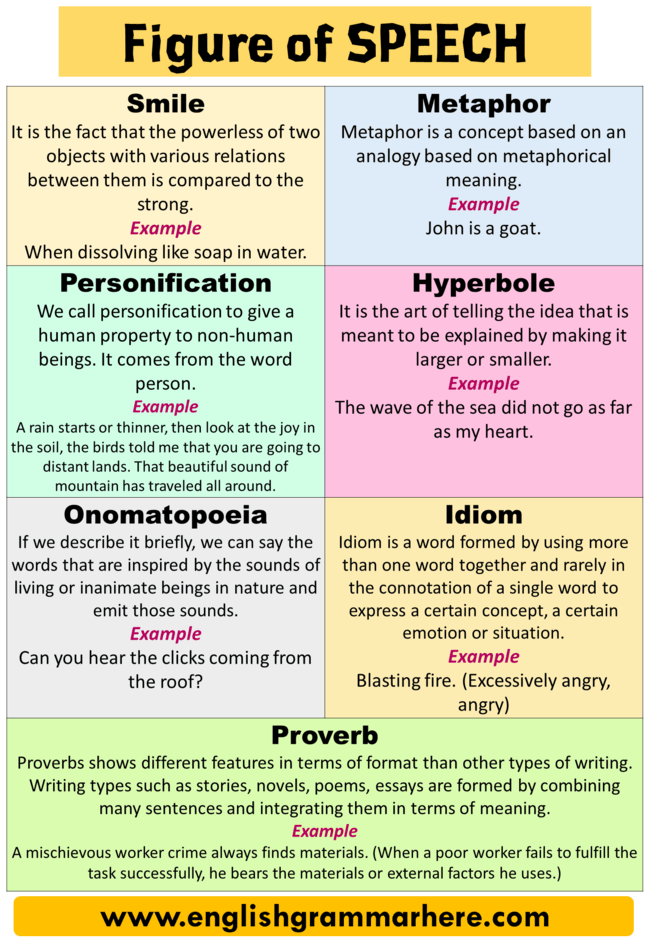
Most figures in everyday speech are formed by extending the vocabulary of what is already familiar and better known to what is less well known. Thus metaphors (implied resemblances) derived from human physiology are commonly extended to nature or inanimate objects as in the expressions “the mouth of a river,” “the snout of a glacier,” “the bowels of the earth,” or “the eye of a needle.” Conversely, resemblances to natural phenomena are frequently applied to other areas, as in the expressions “a wave of enthusiasm,” “a ripple of excitement,” or “a storm of abuse.” Use of simile (a comparison, usually indicated by “like” or “as”) is exemplified in “We were packed in the room like sardines.” Personification (speaking of an abstract quality or inanimate object as if it were a person) is exemplified in “Money talks”; metonymy (using the name of one thing for another closely related to it), in “How would the Pentagon react?”; synecdoche (use of a part to imply the whole), in expressions such as “brass” for high-ranking military officers or “hard hats” for construction workers.
Other common forms of figurative speech are hyperbole (deliberate exaggeration for the sake of effect), as in “I’m so mad I could chew nails”; the rhetorical question (asked for effect, with no answer expected), as in “How can I express my thanks to you?”; litotes (an emphasis by negation), as in “It’s no fun to be sick”; and onomatopoeia (imitation of natural sounds by words), in such words as “crunch,” “gurgle,” “plunk,” and “splash.”
Conceit,
figure of speech,usually a simile or metaphor, that forms an extremely ingenious or fanciful parallel between apparently dissimilar or incongruous objects or situations.
Conceits often were so farfetched as to become absurd, degenerating in the hands of lesser poets into strained ornamentation. In sonnet number 130, William Shakespeare responded to the conventions of the Petrarchan conceit by negating them, particularly in the sonnet’s opening lines:
My mistress’ eyes are nothing like the sun;
Coral is far more red than her lips’ red;
If snow be white, why then her breasts are dun;
If hairs be wires, black wires grow on her head.
I have seen roses damask’d, red and white,
But no such roses see I in her cheeks;
And in some perfumes is there more delight
Than in the breath that from my mistress reeks.
I love to hear her speak, yet well I know
That music hath a far more pleasing sound;
I grant I never saw a goddess go;
My mistress, when she walks, treads on the ground.
And yet, by heaven, I think my love as rare
As any she belied with false compare.
Alliteration
Alliteration is the repetition of the beginning sounds of neighboring words.
Examples include:
- She sells seashells.
- Walter wondered where Winnie was.
- Blue baby bonnets bobbed through the bayou.
- Nick needed new notebooks.
Anaphora
Anaphora is a technique where several phrases or verses begin with the same word or words.
Examples include:
- I came, I saw, I conquered. - Julius Caesar
- Mad world! Mad kings! Mad composition! - King John II, William Shakespeare
- It was the best of times, it was the worst of times, it was the age of wisdom, it was the age of foolishness. - A Tale of Two Cities, Charles Dickens
- With malice toward none; with charity for all; with firmness in the right. - Abraham Lincoln
- We shall not flag or fail. We shall go on to the end... we shall never surrender. - Winston Churchill
Assonance
Assonance is the repetition of vowel sounds (not just letters) in words that are close together. The sounds don't have to be at the beginning of the word.
Examples include:
- A - For the rare and radiant maiden whom the angels named Lenore. (Poe)
- E - Therefore, all seasons shall be sweet to thee. (Coleridge)
- I - From what I've tasted of desire, I hold with those who favor fire. (Frost)
- O - Oh hear old Triton blow his wreathed horn. (Wordsworth)
- U - Uncertain rustling of each purple curtain (Poe)
Euphemism
Euphemism is a mild, indirect, or vague term that often substitutes a harsh, blunt, or offensive term.
Examples include:
- 'A little thin on top' instead of 'going bald.'
- 'Fell of the back of a truck' instead of 'stolen.'
- 'Letting you go' instead of 'firing you.'
- 'Passed away' instead of 'died.'
Hyperbole
Hyperbole uses exaggeration for emphasis or effect.
Examples include:
- I've told you to stop a thousand times.
- That must have cost a billion dollars.
- I could do this forever.
- She's older than dirt.
- Everybody knows that.


Komentar
Posting Komentar