EXPLANATION TEXT
Explanation Text
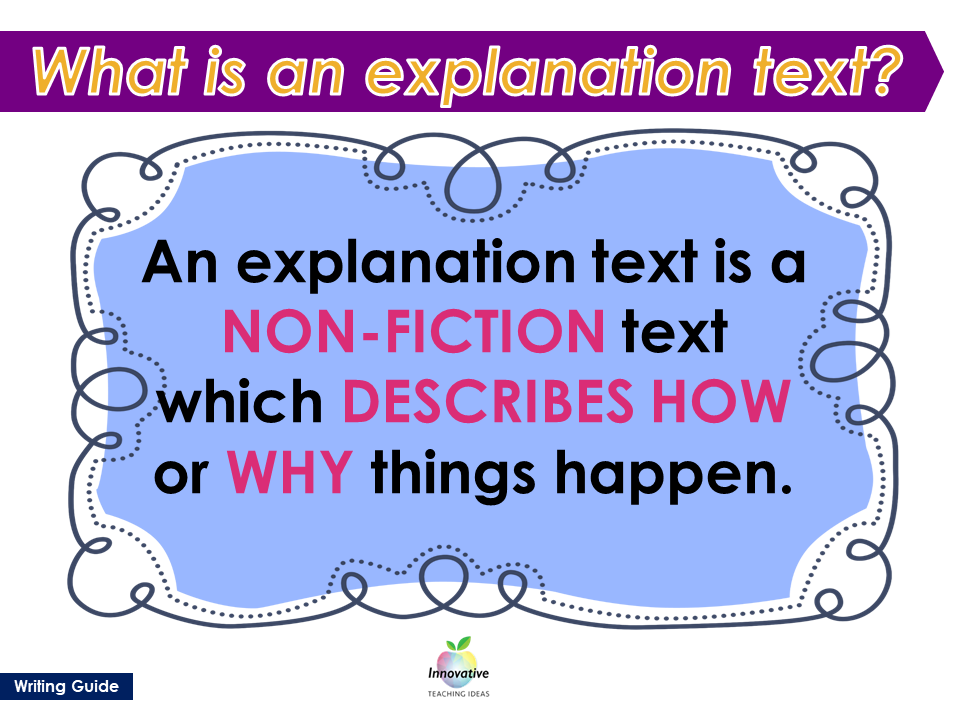
Explanation text is a type of text in English that describes a process. Talking about the process, this text is almost the same as procedure text. However, if the procedure text describes how to do something (process), this text describes how a process occurs. That way, we can know that the explanation text serves to provide information to readers about a process.
Explanation Text Characteristics
There are several characteristics of this text,namely:
Using the Simple Present Tense.
This text uses the Simple Present Tense because it describes facts.
Using Action Verbs
Action Verbs are verbs used to describe an ongoing action. Examples are do, make, create, and so on.
Using Passive Voices
The use of Passive Voices aims to emphasize the focus on the event that is taking place rather than the subject.
Using Noun Phrases
Using Technical Terms
Generic Structure of Explanation Text
There are two parts to the Explanation Text,namely:
1. General Statement
Contains general information on topics to be discussed in the text.
2. Explanation
Contains a series of events (sequence of events) from a process which is the topic of the text. We can also explain by using the why and how questions, so that the explanation we convey is more comprehensive.
3. Closing
The closing or closing part is optional or does not have to be in this text. This section may contain additional information or the author's opinion on the topics discussed.
Example of Explanation Text
How Does Rain Happen
We all know that rain is primary source of fresh water for most areas of the world, providing suitable condition for diverse ecosystems. Rain is water that descends from the sky through several processes until the rain occurs. Do you know how does rain happen?
The phenomenon of rain is actually a water circle. The concept of water circle includes the sun heating the Earth’s water surface and causing the water surface to evaporate. Earth’s water includes water from lake, river, and ocean. Then, the water vapor experiences condensation and becomes condensed vapor. Condensed vapor is formed from droplets so that when the air temperature is higher, it makes the droplets gather, condensed and formed into clouds. The presence of winds helps clouds move and gather in other places that have lower temperatures. At that time, the droplets become heavier and unstoppable and cause the droplets to fall so that there is rain.
If the droplets drop in an area with very cold temperatures, the droplets will drop as snow. However, not all rain reaches the surface. Some evaporates while falling through dry air. This is called Virga, a phenomenon which is often seen in hot, dry desert regions.


Komentar
Posting Komentar